Every citizen. No shortcuts.
There is no fake simulation in The City. Every single resident is simulated in real time: their own job, their own working hours, their own commute, their own paycheck, their own taxes and their own bills. When the population counter says 4,000, that is 4,000 people, each with a name, a home and a bank account.
Real working hours
People go to work when their workplace is open and come home when it closes: offices and banks 8 or 9 to 5, industry 7 to 5, shops 9 AM to 9 PM, groceries 7 AM to 10 PM. They sleep from 11 PM to about 6 AM. You see the rush hour because it is really happening.
Real paychecks
Each resident is paid for the job they actually hold, at the pay for its skill level. Their taxes come out of that pay, and what is left goes into their household's bank account. Nothing is averaged out or made up.
Real money moving
When a family fills up the car, the money goes to that gas station. Rent goes to a landlord who lives in your city. A car payment goes to the dealer. Every dollar comes from someone and goes to someone.
A month in the game is 30 days.
Every price is set by the month, at real US prices. We divide it by 30, because every month in the game has 30 days, and charge that share each game day. Bills that are paid once a month, like health insurance or a car payment, come out on their due day instead. A game day lasts about an hour of real time at normal speed.
A day's rent on an apartment, paid every day of the month.
A day's pay for a skilled shop worker, before taxes.
A day's groceries for one adult, posted to the statement each week.
What people earn.
Set against real US pay: the median full-time worker earns about $5,421 a month. Better jobs need more education, so your schools and colleges now pay off in your residents' pockets, and in your tax income.
| Job, a month | Unskilled | Skilled | Expert |
|---|---|---|---|
| Shops and offices | $3,840 | $5,520 | $9,120 |
| Industry | $4,080 | $5,760 | $8,640 |
| City servicesSchools, hospitals, police, fire and more | $4,320 | $5,760 | – |
| RetiredA pension, not taxed | $1,920 | ||
Skilled jobs need a high school diploma, expert jobs a college degree. Help-wanted ads in the city feed say what a job pays.
See every family's finances.
Click any resident and open View household profile. The household window shows everything that family earns and spends, live, while the city keeps running.
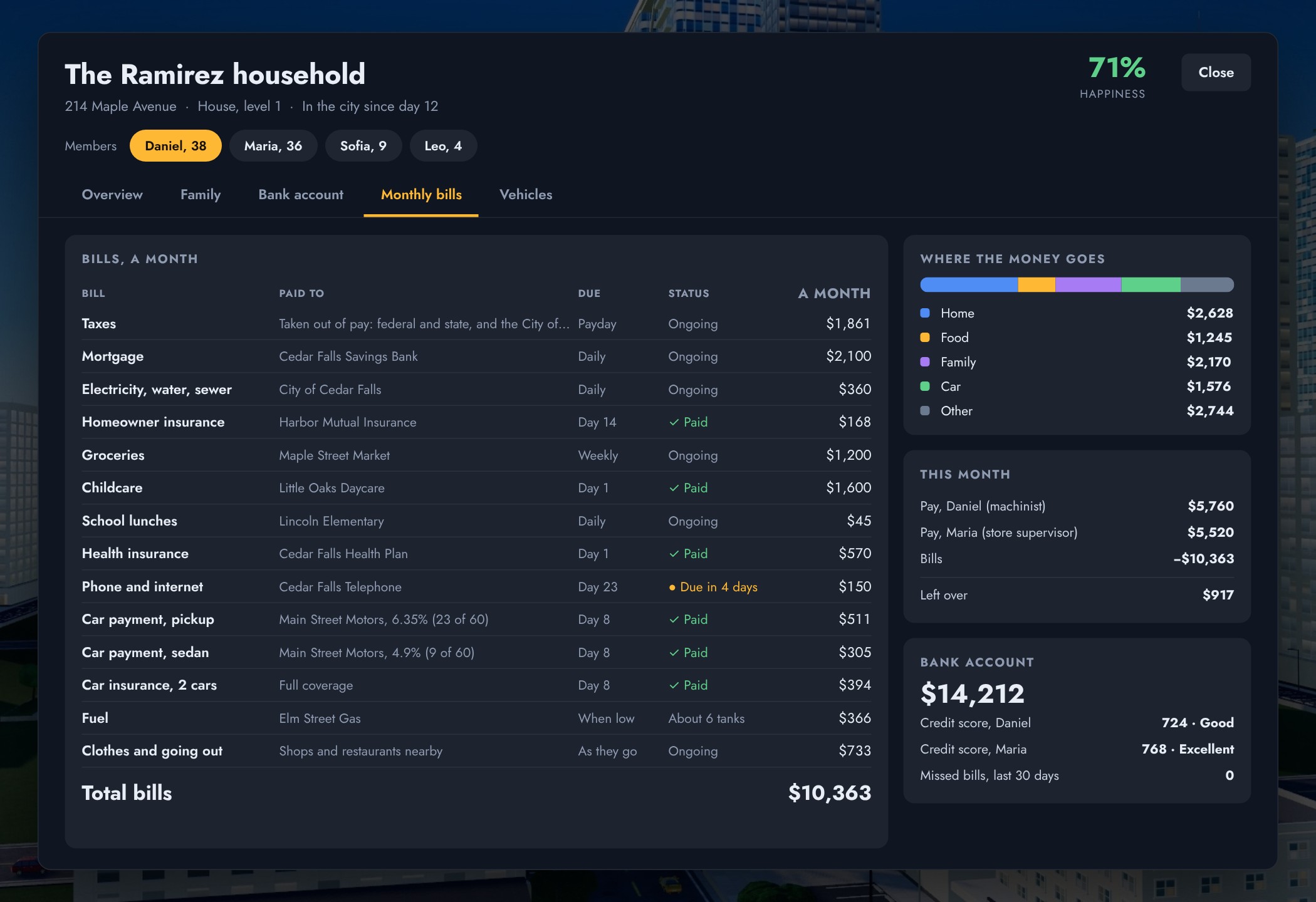
The household window, Monthly bills tab. Two working parents and two children in a house they own, with two cars on loans.
Where a paycheck goes.
One month for a single resident with a skilled shop job, renting an apartment on ordinary land and driving a sedan bought new on a loan. Every line is what the game charges.
- Taxes come out of pay. About 13% goes to federal and state taxes and payroll, which leave the city. Your city's income tax, 3.5% at the usual rate, is what the city keeps.
- Utilities are billed to the household at your city's prices: $1.60 a day for each person's electricity and $0.70 each for water and sewer.
- Living costs are real: groceries at $350 a month for each adult and $250 for each child, health insurance ($120 alone, $570 for a family), phone and internet at $150, clothes at 2.5% of pay and going out at 4%.
- Going out stops first. A household that is short of money stops going out and shopping before it misses a bill.
Homes: owners, renters and landlords.
Who owns a building now matters, and the money for it goes to a real person.
Houses are owned
A single-family house belongs to the family who lives in it. They pay a mortgage of $2,100 a month to their bank. A house is worth around $200,000, from 0.7 times that on run-down land to 1.3 times on prime land.
Landlords live in your city
Apartments ($1,450) and flats in towers ($1,900) are rented. The rent goes to a landlord who is one of your own residents, usually a homeowner with money put by. They pay your city income tax on the rent they collect, and it shows in your treasury.
Selling a home
When a family moves away, their house goes up for sale, and nobody moves in until it sells. With a real estate office nearby it sells in about 2 days, for a 3% commission to the office. Without one, it takes a week or more.
Rent and mortgages follow the land: 0.7 times on run-down land, 1.3 times on prime land. The district policy Rent control takes a fifth off. With nobody in the home earning, housing assistance pays half.
Cars cost what cars cost.
Every car on your roads belongs to a resident who is paying for it, fueling it and keeping it running.
Insurance, storms and who pays.
Health insurance is part of every working household's bills. With the Force of Nature DLC, homes and businesses need insurance too, because storms do real damage and somebody has to pay to put it right.
Homeowner insurance Force of Nature
Build an insurance office and the buildings in its reach take out policies over a few weeks. The premium is about 8% of a month's rent or mortgage, more where tornadoes, earthquakes or forest fires are likely and less behind braces and walls. Flood insurance is a separate policy, offered only where water can reach.
Hail and storm damage Force of Nature
A hail storm can damage the roofs across part of a city. An insured owner pays the deductible, $500 on a house or $2,000 on anything else, and the insurer sends a contractor at once. An uninsured family pays the whole bill and is unhappy while they do. A family that cannot pay lives with the damage, then after a week sells cheap and moves away.
Contractors and help Force of Nature
Repairs are done by a roofing company or a general contractor, three jobs at a time. With none in your city, an out-of-town firm comes half a day later and charges half as much again. You can have the city pay a quarter or half of home premiums: more families take out a policy, and they are happier for it.
Every resident has a credit score.
Credit is earned the way it is in real life, from 300 to 850. It shows on the household's Bank account tab, and it decides what a loan costs. A resident who lives a steady life borrows cheaply; one who misses payments, lives on run-down land or has no steady income pays a lot more for the same car.
- Paying on time matters most. Every missed bill in the last year pulls the score down, and a car taken back pulls it down hard.
- A steady job helps, and months in the same job help more. No income hurts.
- Where they live counts: homes on prime land help, homes on run-down land in a rough part of town hurt.
- Money in the bank helps. Living paycheck to paycheck, or a car payment that takes a big share of pay, hurts.
- Credit recovers. A resident who gets back on track sees their score climb back up month by month.
| Credit score | New car | Used car |
|---|---|---|
| Excellent760 to 850 | 4.9% | 7.5% |
| Good700 to 759 | 6.35% | 11.19% |
| Fair640 to 699 | 9.5% | 14.5% |
| Poor580 to 639 | 13.5% | 19% |
| BadUnder 580 | – | 22% |
A year's interest rate on a 60-month loan. With bad credit no dealer will finance a new car: it is a used car or nothing.
Missed bills, credit and happiness.
- A bill they cannot pay is missed. It is part-paid with whatever is in the account, and the rest is marked Missed on the statement.
- Credit follows. Every missed bill lowers the credit score, and the next loan costs more.
- The car goes back after two missed car payments.
| How their money makes them feel | Happiness |
|---|---|
| Money in the bank | +3 |
| Living paycheck to paycheck | −3 |
| Behind on billsMore for each missed bill | −6 to −14 |
The city's side of it.
Your treasury now moves at the same scale as your residents' wallets.
- $250,000 to start. Enough for power, water, sewers, a school, police, fire and your first streets of homes. It is not enough for everything at once.
- Buildings cost about three months of their running costs, staff wages included. A service that needs a lot of staff costs more to open.
- Utilities pay for themselves. Power, water and sewer prices are realistic, and the plants' running costs match them. City Hall's sliders show what a resident pays a month.
- Income tax comes out of pay. The city keeps 3.5% at the usual rate, plus income tax on the rent your landlords collect. Raise it and residents feel it; lower it and your treasury does.
- Your cities come with you. A city saved before 1.9 moves onto the new prices at its first midnight, keeping any price you set above or below the usual rate.
Why this makes the game balanced.
Before 1.9 the money in The City did not add up. Rent went to nobody, utilities cost a few cents and a car cost $250. Economy Plus ties every number to the real world, so your choices have consequences that make sense.
| Before 1.9 | Economy Plus | |
|---|---|---|
| Starting money | $20,000 | $250,000, with building prices to match |
| Rent | Charged per person, and paid to nobody | One rent or mortgage per home, paid to a landlord or bank in your city |
| Utilities | A few cents a unit | Real prices, billed to the household, with plant costs to match |
| Taxes | A share of each day's pay | Federal, state and city tax taken out of every paycheck |
| Cars | $250 from savings | $1,800 down, a 60-month loan at a rate set by their credit score, insurance, gas and repairs |
| Fuel | Not paid for | Bought at your city's gas stations, by the tank |
| Credit | None | A credit score for every resident, from 300 to 850, that sets their loan rates |
| Homes | Nobody owned anything | Owned houses with mortgages, landlords, home sales and real estate offices |
- Jobs and education matter. A city of unskilled jobs pays less, so its people live closer to the edge and pay less tax. Schools and colleges lift both.
- Your prices land on real people. Raise taxes or utility prices too far and families start missing bills, their credit scores drop, their loans cost more and they get unhappy.
- Neighbourhoods matter. Run-down land means lower credit and dearer loans, so a rough part of town is harder to climb out of. Lift the land value with parks, schools, police and street lights, and its people do better.
- Businesses earn from residents. Gas stations, car dealers, garages, grocery stores and real estate offices all take in money from the households around them.
- Growth has to be paid for. With realistic building and running costs, expanding too fast empties the treasury, while a well-run city with good jobs and fair prices builds up money to grow.
Coming October 27th
Economy Plus goes out to play testers first. Want to try it? Sign up to play test, or follow along in the news.