Home › City services › Transportation

Transportation

Draw the roads. Run the buses.

Roads carry traffic, decide where lots can go, and carry electricity, water and sewers to everything beside them. Every car belongs to someone and is going somewhere, so a bad junction really jams, and fixing it really works.

  • Roads at any angleStreets, one-way roads, avenues, boulevards and highways.
  • Buses in three stepsA depot, stops, then routes drawn stop by stop.
  • Trains and planesStations and airports bring visitors to the city.
  • Parking for 1,200Garages from 60 cars up to the mega garage.

Roads and highways

RoadLanesPrice
Street2$5 a unit
One-way street2, one way$5 a unit
Avenue4$9 a unit
Boulevard6$13 a unit
HighwayFast, barrier down the middle$14 a unit
RampsOne-way or two-way$8 to $10 a unit

Building lots only appear along streets, avenues and boulevards. Nothing is built alongside a highway.

  • Straight, curved, circle or grid. The tip shows the angle as you draw. A one-way circle makes a roundabout.
  • Ready-made grids lay down a whole neighbourhood, streets and zoning included.
  • Raised highways climb onto a deck so roads on the ground pass beneath with no junction.
  • Interchanges and roundabouts come ready-made, from a diamond to a cloverleaf.
  • Your way in from the outside world is a highway. Do not cut it off.

Roads guide · Highways and ramps · Every road, sign and garage

Junctions, signs and lane rules

Junctions guide

With no signs, the through road goes first and side roads wait. Four-way junctions get traffic lights by themselves, with an amber phase. Nobody enters a junction unless there is room to leave it.

SignPriceWhat it does
Traffic lights$200 a junctionTakes turns between the roads
Stop or yield signs$50 a junctionStops the traffic on the side you click
Crosswalk$30 eachPeople cross here, and cars stop for them
No U-turn, no left, no right$20Bans that turn

Lane rules: click a junction and choose which lane may go left, ahead or right. Arrows are painted on, and drivers pick their lane to match. Auto fix eases awkward junctions so roads meet square.

A four-way junction of wide avenues downtown on a winter evening in The City, with traffic lights, crosswalks on every side and red and green stop lines on each approach
A four-way junction downtown. Four-way junctions get traffic lights by themselves, and the stop line on each road shows red or green.
The junction details panel for Maple Rd, Pine Rd and Walnut Rd in The City, with Lane rules open: one road into the junction is highlighted in yellow and a row of turn arrows is shown for each of its lanes
The details of one junction, with Lane rules open. The road being set is highlighted, and each of its lanes has its own row of turns.

Rules for every road at every junction

Click any junction to open its details: what runs it, how many roads meet there, how many cars are stopped, crashes so far and drivers ticketed.

  • Lane rules. For each road arriving at the junction, choose which lane may go left, ahead, right or make a U-turn. Arrows are painted on the lanes you set, drivers get into a lane that allows their turn, and a turn no lane allows sends them another way.
  • Signs per road. No left turn and No right turn go on a road where it comes into a junction, so they apply only to traffic arriving on that road. Stop and yield signs stop the side you click.
  • Auto fix eases the roads into the junction so they meet in line and square. Request patrol posts a police car there for about four game hours.

A change applies to drivers who set off from now on. Junctions you leave alone work as they always have. Source: the junctions, signs and lanes guide.

  1. Build a bus depotIt keeps twelve buses and needs a wide lot. No depot, no buses.
  2. Place bus stopsEach stop gets a lay-by, so the bus pulls in off the road. Put stops on the side the bus drives on.
  3. Draw routesClick the stops in order. Plus and minus set how many buses run. Each bus costs money every day.
  • Buses run from 5 am to 11 pm and sit in the same traffic as everyone else.
  • Each bus seats 40. If no bus comes in about three and a half hours, people give up and walk.
  • People with a car take the bus for some trips when a route runs from near their door to near where they are going.
  • People walk twice as far to a stop outside a central bus station.
  • With no bus, people with no car hail an Uber, and the city takes a licence fee.
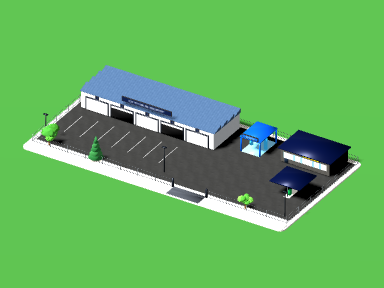
Bus depot, as it looks in the game

Bus depot

Keeps twelve buses. Every bus on a route comes out of one in the morning and goes back at night.
Cost
$85,000
Running cost
$80 a day
Lot
Wide
Staff
6
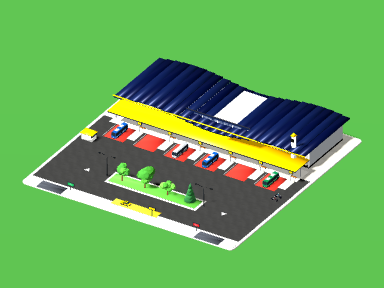
Central bus station, as it looks in the game

Central bus station

A terminal with a waiting hall. Run your routes through a stop outside it.

Cost
$120,000
Running cost
$144 a day
Lot
Large
Staff
8

A bus stop costs $150, then $16 a day.

Stations and airports

Transport reference

Stations and airports bring visitors, and airports also bring new residents faster.
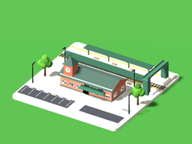
Train station, as it looks in the game

Train station

Trains bring visitors.

Cost
$84,000
Running cost
$64 a day
Visitors
150
Staff
6
Grand central station, as it looks in the game

Grand central station

Trains bring many visitors. Needs a wide lot.
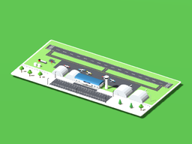
Cost
$200,000
Running cost
$192 a day
Visitors
450
Staff
14
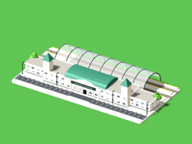
Airfield, as it looks in the game

Airfield

A small airport. Flights bring visitors, and new residents arrive faster. Noisy nearby.
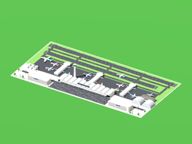
Cost
$430,000
Running cost
$480 a day
Visitors
400
Staff
30
International airport, as it looks in the game

International airport

Far more visitors, and residents arrive faster still. Noisy nearby. Needs a vast lot.
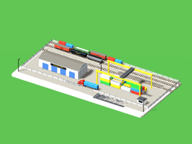
Cost
$1,710,000
Running cost
$1,760 a day
Visitors
2,000
Staff
120
Freight rail yard, as it looks in the game

Freight rail yard

Jobs in freight. Needs a wide lot.

Cost
$140,000
Running cost
$80 a day
Lot
Wide
Staff
10

Homes near an airport are less happy, and airports give off heavy pollution over a wide area.

Parking and cars

Parking guide

Not everyone has a car. Better-off people arrive with one; others buy one at a car dealership once they have saved enough. People with no car walk, take the bus, or hail an Uber. At the end of a trip a driver looks for the building's own car park first, then a garage within a walk, then the nearest free kerb.

  • Towers do not swallow cars: build garages downtown, or the streets round the towers fill up.
  • Click a garage to set its price and see what it earned. Drivers who will not pay your price say so.
  • A driver low on fuel stops at a gas station. With none in reach they fill up out of town, and that money leaves the city.
GarageCarsCost
Small garage60$15,000
Large garage200$30,000
Underground garage400$88,000
Large parking garage450$49,000
Tall parking garage1,000$52,000
Mega parking garage1,200$85,000

More garage sizes are in the roads, signs and parking reference.

A multi-storey parking garage with a blue P sign, lit up at night in a snowy downtown in The City, with cars parked on every floor and towers around it
A parking garage downtown at night: the cars of the people around it are inside, not lining the street.

Why it matters

Parking garages keep a city moving

Every car in The City is a real car that has to stand somewhere, between every trip. Towers do not swallow cars, so a busy downtown needs garages.

  • No parking, no drive. Nobody drives somewhere they cannot park. If there is no space at the building, no garage within a walk and every kerb nearby is full, people walk, take the bus or hail an Uber instead, and City Hall (Transport, Parking) shows you every place drivers found nowhere to park.
  • Kerbs fill up first. Without a garage, cars line the streets round the towers. When a garage is full, or charges more than drivers will pay, they park at the kerb instead, and that backs the streets up.
  • Homes and jobs both need them. People with no space of their own keep their car in a garage near home, and drivers park in a garage near work. Cars left at a garage are collected on the way home.
  • They pay their way. Click a garage to set its price and see what it earned today, in 7 days and in 30 days. Price it too high and drivers pass it by for a cheaper one, or the street.
  • The no-parking rule needs them. Turn on no parking on the street and residents with a garage within reach of home enjoy clear, quiet streets. Without one, drivers are unhappy about it. Build garages first.

Fixing a traffic jam

Open the Planner to see what share of cars are standing still, then follow the queue to its head. The cause is there.

At the head of the queueFix
A crashPolice and a tow truck clear it. Make sure a police station reaches the street
One junction taking every carBuild a second route, or widen the road in
Left turns blocking a laneLane rules, a No left turn sign, or a roundabout
Junctions too close togetherRemove one, or make a street one-way
Cars hunting for parkingBuild garages
Everyone drivingBus routes and walking paths
Through traffic on local streetsA highway, or a raised highway over the top
SnowA public works depot to plough the roads

People stuck in jams are less happy. A driver who has not moved at all in two minutes gives the trip up and goes home.

The full traffic and transport guides

Roads, junctions, buses, parking and how to clear a jam, step by step, in the Municipal Code.

Figures are from the game's own data, version 1.9, as listed in the Municipal Code. Numbers can change between versions.

Coming to Steam Early Access

Achievements, play with a friend, and your city on your own player page. The store page is linked here the moment it opens.